
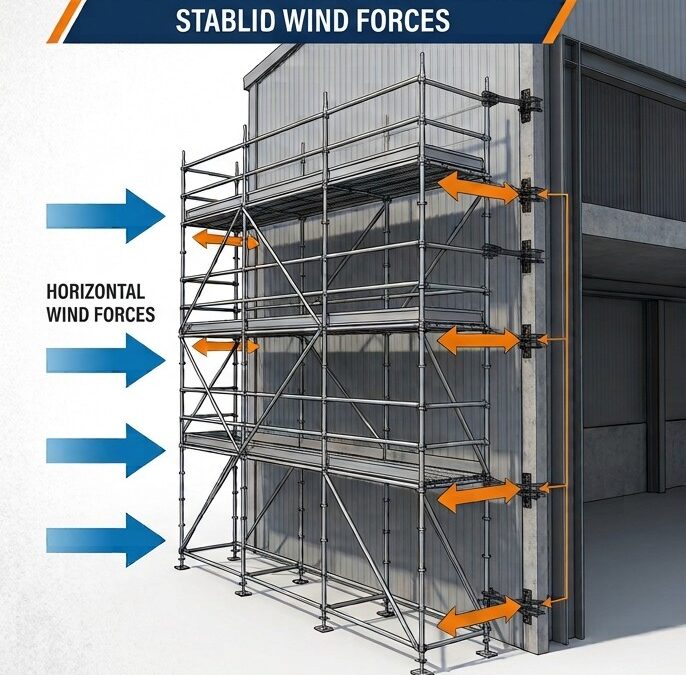
When designing a scaffold, it is easy to focus on the working platforms, access arrangements and overall dimensions. However, one of the most important aspects of a scaffold’s stability is often less visible: the tie pattern.
Scaffold ties connect the scaffold to a supporting structure and help control how the scaffold behaves under applied loads. The position, spacing and arrangement of these ties can have a significant influence on the scaffold’s stability, wind resistance and overall structural behaviour.
A scaffold is not simply a collection of tubes and fittings. Once erected, it behaves as a structural system, and the tie arrangement forms an important part of that system.
What Is a Scaffold Tie Pattern?
A scaffold tie pattern refers to the arrangement and spacing of the connections between the scaffold and the supporting building or structure.
The exact arrangement depends on factors such as:
-
Scaffold height and configuration
-
Scaffold width and length
-
Building geometry
-
Scaffold loading
-
Wind exposure
-
Type and location of the supporting structure
-
Sheeting, netting or other coverings
-
Access requirements
-
The overall structural design
A tie pattern therefore should not simply be selected because it was used successfully on another project. The conditions of each scaffold need to be considered individually.
Stability
One of the primary purposes of scaffold ties is to help provide stability.
A scaffold can be relatively stable at its base while becoming increasingly susceptible to movement as its height increases. As the scaffold gets taller, the effects of horizontal forces and the potential for lateral movement become increasingly important.
Ties help connect the scaffold to the building and provide restraint against movement. Together with the scaffold's bracing, standards, ledgers, transoms and base arrangement, the ties contribute to the overall stability of the structure.
A suitable tie pattern helps ensure that the scaffold behaves as an integrated system rather than as a freestanding structure relying solely on its base.
This becomes particularly important where the scaffold is tall, heavily loaded or exposed to significant external forces.
Wind Resistance
Wind is one of the most important environmental loads to consider when designing a scaffold.
A scaffold can be relatively open, allowing much of the wind to pass through it. However, adding sheeting, advertising material, debris netting or other coverings can significantly alter how wind interacts with the structure.
These materials can increase the effective area exposed to the wind and consequently increase the forces transferred into the scaffold and its ties.
This is why a tie arrangement suitable for an open scaffold may not necessarily be suitable for a scaffold with extensive sheeting or screening.
Wind forces can also vary depending on the location and surroundings of the scaffold. A scaffold positioned around a tall building, in an exposed area or near the edge of a structure may experience different conditions from one located in a more sheltered environment.
The tie pattern is therefore an important part of considering how wind loads are transferred from the scaffold into the supporting structure.
Structural Behaviour
The tie pattern also affects how the scaffold behaves as a complete structural system.
For example, if ties are concentrated in certain areas while other sections have limited restraint, the scaffold may not behave in the way expected from a simple visual inspection.
The interaction between ties and the rest of the scaffold structure is important. Standards, ledgers, transoms and bracing work together to transfer loads through the scaffold, while the ties provide restraint and transfer forces into the supporting structure.
This means that changing the position of a tie can sometimes have consequences beyond that individual connection.
A practical example would be a scaffold where an obstruction prevents a tie from being installed at its designed location. Moving that tie may affect the surrounding structural arrangement. Depending on the scaffold design, the appropriate solution may involve an alternative tie position, additional restraint or a revised design.
Why Tie Spacing Should Not Be Assumed
One of the common mistakes with scaffold design is treating tie spacing as a fixed rule that can be applied to every project.
In reality, the appropriate arrangement depends on the specific scaffold and its conditions.
Consider two scaffolds with the same height. One may be a relatively narrow access scaffold with open sides and limited loading, while the other may extend around a large building and be covered with sheeting.
Although their heights may be similar, their structural requirements can be very different.
Other factors can also influence the design, including:
-
Scaffold loading requirements
-
Number and location of working platforms
-
Scaffold dimensions
-
Cantilevers or unusual configurations
-
Building shape
-
Openings and obstructions
-
Wind exposure
-
Sheeting or screening
-
Restrictions on where ties can be installed
This is why tie patterns should form part of the scaffold design rather than being treated as an afterthought during erection.
What Happens When a Tie Cannot Be Installed?
Construction sites rarely go exactly according to the original plan.
A tie location shown on a drawing may become unavailable because of a doorway, window, cladding, architectural feature, plant or another obstruction.
This does not necessarily mean the scaffold cannot be erected, but it does mean the change needs to be considered.
Simply removing a tie or moving it to an arbitrary location can change the structural behaviour of the scaffold.
Where site conditions prevent the intended tie arrangement from being followed, the scaffold design should be reviewed so that an appropriate alternative can be established.
This is one of the reasons clear scaffold drawings are valuable on site. They provide the erection team with a defined arrangement and make it easier to identify where site conditions differ from the original design.
Tie Patterns Are Part of the Bigger Picture
A scaffold tie pattern should never be considered in isolation.
The overall scaffold design needs to consider how the different components work together, including:
Base → Standards → Ledgers & Transoms → Bracing → Ties → Supporting Structure
Loads need to be transferred through this system in a controlled manner.
The scaffold design should therefore consider not only where the ties are positioned, but also how the scaffold will be loaded, how it will respond to horizontal forces and how those forces will ultimately be transferred into the supporting structure.
Designing for the Actual Scaffold
Every scaffold project has its own combination of constraints and requirements.
A well-considered tie pattern can contribute to:
-
Improved scaffold stability
-
Resistance to lateral movement
-
Effective transfer of wind forces
-
Predictable structural behaviour
-
Safer and clearer erection
-
Better coordination between the scaffold and building
At Scaffold Design, we provide scaffold design and engineering support for projects where clear, practical and project-specific drawings are required.
Our designs consider the intended scaffold configuration and the conditions that influence its structural behaviour, helping contractors have a clear design basis before erection begins.