
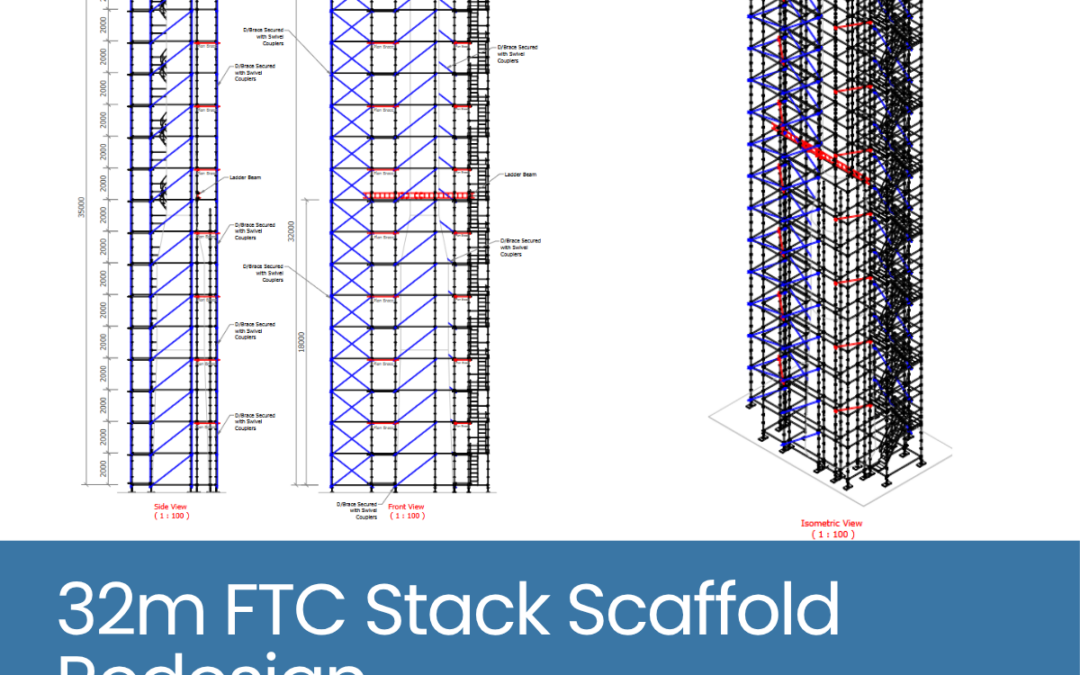
Designing Safer and More Practical Access for a 32 m High Stack
Scaffold design is not simply about providing a temporary working platform. On industrial projects, the scaffold must provide safe access, allow maintenance activities to be carried out efficiently, and work within the physical constraints of the structure and site.
One such project involved the redesign of scaffold for a SMELTER BAKING FURNACE FUME TREATMENT PLANT Stack in Maputo, Mozambique. The scaffold was required to provide access to a tall stack so that maintenance personnel could safely carry out work at various levels.
With the scaffold reaching approximately 32 metres in height, access became one of the important considerations in the redesign.
The Project
The project involved providing scaffold access around a tall industrial stack associated with a smelter baking furnace fume treatment plant.
The purpose of the scaffold was to provide temporary access and working areas for personnel carrying out maintenance on the stack.
At approximately 32 m high, the scaffold presented a significant vertical access requirement. Personnel and equipment needed to travel between ground level and the various working levels of the scaffold.
The existing access arrangement incorporated a ladder system. While ladders can provide a practical solution for many scaffold applications, the height and nature of this particular project required us to consider whether a different access arrangement would provide a more practical solution for the people using the scaffold.
Redesigning the Access System
As part of the scaffold redesign, the ladder system was replaced with a scaffold staircase.
The objective was straightforward: improve the practicality of moving personnel and equipment up and down a 32 m high scaffold.
A staircase provides a different method of vertical movement compared with a ladder. Personnel can walk between levels rather than continuously climbing a ladder, making repeated movement through the scaffold more practical.
This was particularly relevant for a maintenance application where personnel may need to travel between the ground and elevated working areas multiple times during the project.
The staircase also provides a more practical route for transporting tools and equipment compared with relying solely on a ladder system.
Why Access Matters on Tall Scaffolds
When designing scaffold around a tall industrial structure, access should be considered as part of the overall scaffold system rather than as an afterthought.
A scaffold can provide a structurally suitable working platform, but if personnel have difficulty reaching the working area, the effectiveness of the scaffold can be reduced.
At 32 m, the vertical distance involved in this project made the access arrangement particularly important.
For maintenance teams, the ability to move efficiently between levels can have a direct impact on how easily work can be performed. Tools, equipment and personnel all need to reach the working areas, while the scaffold must remain organised and suitable for the intended application.
The redesign therefore considered not only where people would work, but also how they would get there.
A Practical Industrial Scaffold Solution
Industrial scaffold projects often involve structures that were never designed with temporary scaffold access in mind.
Stacks, tanks, processing equipment and other industrial structures can have restricted access areas, unusual geometry and operational constraints. Scaffold design therefore needs to account for the actual application and the requirements of the maintenance team.
For the FTC Stack project, the redesign provided a more practical access arrangement by incorporating a scaffold staircase into the overall scaffold configuration.
The result was a scaffold system designed around the maintenance requirements of the project rather than simply providing a basic vertical access route.
Design Considerations
A scaffold reaching approximately 32 m requires careful consideration of the overall configuration.
Depending on the project, factors such as scaffold height, stability, access, working platforms, tie arrangements, bracing and the surrounding structure can all influence the final design.
For this project, the access arrangement was one of the key areas addressed during the redesign.
The staircase needed to be incorporated into the scaffold while maintaining the required working areas and providing a practical route through the structure.
This highlights an important part of scaffold design: the scaffold needs to work for the people who will actually use it.
Supporting Maintenance Work
The ultimate purpose of the scaffold was to support maintenance activities on the tall FTC Stack.
That means the scaffold had to do more than simply reach the required elevation. It needed to provide usable access to the work area and allow maintenance personnel to move through the scaffold efficiently.
Replacing the ladder system with a scaffold staircase was therefore a practical design decision based on the requirements of the application.
For a 32 m high scaffold, small decisions regarding access can have a significant effect on the day-to-day usability of the structure.
Our Approach to Scaffold Design
At Scaffold Design, we provide scaffold design and drawing services for industrial and commercial applications.
Every project has its own requirements. Some involve straightforward access scaffolds, while others require more detailed solutions around industrial equipment, structures and maintenance requirements.
Our role is to translate the requirements of the project into a practical scaffold design that can be communicated clearly through technical drawings and documentation.
The FTC Stack project is a good example of how scaffold design can be adapted to improve the practical use of a scaffold.
The challenge was not simply getting personnel to a height of 32 m. It was providing an access solution that better suited the maintenance work being carried out at that height.
Looking Beyond the Scaffold
Good scaffold design considers the complete working environment.
Where will personnel enter the scaffold?
How will they move between levels?
How will tools and equipment reach the working area?
What restrictions are imposed by the existing structure?
These questions become increasingly important as scaffold height and project complexity increase.
The FTC Stack project in Maputo demonstrates how an existing scaffold concept can be reconsidered and redesigned when the practical requirements of the users are taken into account.
A scaffold staircase may seem like a relatively simple change, but on a 32 m high industrial scaffold, improving the access arrangement can make a substantial difference to how the scaffold is used.
Need scaffold design or technical drawings for an industrial project?
Contact Scaffold Design to discuss your requirements and see how we can assist with your next scaffold project.